


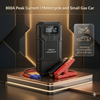
What Is A Good Car Jump Starter?
par SAFEMATE
par SAFEMATE
Imagine this: You are running late for an important business meeting, or worse, you are stranded in a dark, isolated parking lot late at night. You hop into your vehicle, turn the key or press the start button, and... nothing. Just a heartbreaking click-click-click noise. Your car battery is dead.
In the past, a dead battery meant flag-waving a stranger for help, dealing with messy, tangled jumper cables, or waiting hours for an expensive tow truck. But times have changed. Today, savvy drivers rely on the best portable car jump starter—a compact, lightweight device that lives in your glove box or trunk and can bring your vehicle back to life in seconds, entirely on your own.
However, if you search online, you will find hundreds of options boasting massive numbers, flashing lights, and complex technical jargon. If you are a regular car owner who isn't a mechanic, it is easy to feel overwhelmed. What is a good car jump starter? How much power do you actually need? Are they safe?
This comprehensive jump starter buying guide will cut through the marketing noise. We will break down exactly how a portable car jump starter works, what technical specs actually matter, and how to choose the perfect model for your specific vehicle and lifestyle.
Before diving into specifications, let's establish a clear baseline: what is the best portable jump starter designed to do, and how does it differ from traditional methods?
A portable car jump starter is essentially a high-capacity, specialized lithium-ion battery pack engineered to deliver a massive burst of electrical current in a split second. Unlike traditional jumper cables, which require a second "donor" vehicle to transfer power from one battery to another, a portable unit acts as an independent power station. It provides the immediate energy your vehicle's starter motor needs to crank the engine over.
Once the engine fires up, your vehicle's alternator takes over, running the car and recharging your built-in car battery. The beauty of a modern lithium-powered jump starter lies in its size and convenience. Old-school lead-acid jump starters weighed 20 to 30 pounds and felt like carrying a cinder block. Today's premium lithium models are roughly the size of a hardcover book, weigh less than three pounds, and can hold their charge for months at a time.
But a great jump starter isn't just a single-use tool. Modern devices have evolved into multi-functional emergency survival kits, boasting built-in LED flashlights, USB charging ports for your smartphones, and even integrated air compressors for flat tires. It is peace of mind wrapped in a compact package.
When figuring out how to choose jump starter units, your very first starting point shouldn't be the price or the coolest features. It must be your vehicle. A jump starter that easily fires up a compact commuter hatchback will completely choke if you try to connect it to a massive V8 diesel pickup truck.
Evaluating a jump starter boils down to two major dimensions: Compatibility (matching your specific car) and Performance (how efficiently the device delivers power). Let's look closely at compatibility first.
Different vehicles require drastically different amounts of power to turn over their engines. Standard sedans and compact crossover SUVs have small, lightweight moving parts in their engines, requiring relatively low energy. On the flip side, full-size pickup trucks, heavy-duty commercial vans, and large watercraft have massive pistons and heavy internal components that require immense force to move.
This is where many everyday buyers make a critical mistake. You must look at your vehicle’s engine displacement, measured in liters (L), and note whether it runs on Gasoline or Diesel.
Consequently, a jump starter rated for an 8.0L gas engine might only be rated for a 6.0L diesel engine. Always read the manufacturer’s specifications to ensure your vehicle's engine size falls comfortably within the device's limits.
Once you know your vehicle's requirements, you need to understand product performance. If you want to know what is a good car jump starter, you have to look past flashy exterior designs and examine the internal hardware, safety features, and battery metrics.
When shopping, you will see numbers like 1000A, 2000A, or 4000A printed in bold letters on the packaging. These refer to electrical current, but not all amp ratings are created equal.
Peak Current (Peak Amps): This represents the absolute maximum electrical current a jump starter can discharge in a tiny fraction of a second (typically 20 to 50 milliseconds). While a high peak amp rating indicates a powerful battery cells inside, it doesn't tell the whole story. A car cannot start on a 20-millisecond pulse alone; it requires a sustained flow of energy to turn the engine over completely. Therefore, a higher peak amp number does not automatically mean superior real-world performance.
To understand the sustained flow, we must look at how the device performs over a longer stretch, usually up to 30 seconds. Depending on environmental conditions, this is measured in two ways:
Why does Cold Cranking Amps (CCA) matter so much? When temperatures drop below freezing, two negative things happen simultaneously: your car's engine oil thickens (becoming syrupy and harder to pump), and your car's internal battery loses up to 50% of its chemical efficiency. If you live in a region that experiences harsh winters, your portable jump starter's CCA rating is its most critical metric.
Take a look at your physical car battery under the hood; you will see a CCA rating printed right on the top label (standard passenger cars usually require between 400 to 500 CCA). For optimal performance, you want a portable jump starter whose sustained cranking power matches or exceeds your vehicle battery’s factory ratings.
If Amps represent the speed and force of the electrical current, Watt-Hours (Wh) represent the total volume of fuel in the jump starter's tank. A higher Wh rating means the device stores more total energy. A jump starter with a large capacity can jump-start a car 20 to 30 times on a single charge, or it can jump-start a stubbornly dead car multiple times in a row without running out of juice. It also means you will have plenty of power left over to use the device as a portable power bank for your electronics.
Electricity can be dangerous if mishandled. A high-quality jump starter must prioritize reliability and structural safety, utilizing heavy-duty fireproof materials and smart internal circuitry. Look for units equipped with ultra-safe spark-proof technology and error-proof reverse polarity protection.
Reverse polarity protection means that if you accidentally connect the red positive clamp to the negative terminal of your car battery, the device will instantly cut off power and sound an alarm rather than causing a dangerous electrical short, melting cables, or damaging your car's sensitive onboard computers.
The best battery cells in the world are useless if the energy cannot transfer efficiently to your car. Pay close attention to the jumper clamps. You want thick, heavy-duty, heavily insulated clamps with robust internal copper teeth. The clamps should have a strong spring tension to grip terminal posts firmly, and the cables must be long enough to comfortably reach your battery terminals even if they are spaced far apart.
Since you won't be jump-starting a car every day, look for units that provide daily value and emergency versatility. The top-rated options on the market offer:
To help you visual what to look for, here is a breakdown of how specific features map across different types of vehicles and drivers. This comparison table serves as a quick reference guide on how to choose jump starter parameters effectively.
| Vehicle Category | Engine Type & Size Examples | Recommended Peak Current | Key Features to Prioritize | Best Matching Solution |
|---|---|---|---|---|
| Compact / Sedan | Up to 4.0L Gas / 2.0L Diesel (Civic, Corolla, Camry) | 800A - 1200A | Ultra-compact size, lightweight, USB-C ports for gadget charging. | Standard Compact Jump Starter |
| Family SUV / Crossover | Up to 6.0L Gas / 4.0L Diesel (RAV4, Explorer, Grand Cherokee) | 1500A - 2000A | Balanced capacity (Wh), long jumper cables, multi-mode LED emergency lights. | SAFEMATE Mid-Range Series |
| Heavy-Duty Truck / Commercial | Up to 8.0L+ Gas / 6.0L+ Diesel (F-150, Ram 2500, Large Boats) | 2500A - 4000A+ | High Cold Cranking Amps (CCA), large battery capacity, rugged drop-proof housing. | SAFEMATE Pro Heavy-Duty Elite |
| The Ultimate Preparedness Kit | All standard passenger vehicles & trucks | 2000A+ | Built-in Air Compressor, intelligent digital LCD screen, multi-port output. | SAFEMATE All-in-One Power Station |
If you are wondering where to buy jump starter models that tick all of these boxes without breaking the bank, look no further than SAFEMATE (safematestore.com).
At SAFEMATE, we design our emergency power solutions specifically for everyday drivers who demand industrial-grade reliability. SAFEMATE portable jump starters are engineered with cutting-edge, spark-proof internal circuitry and intelligent reverse-polarity protections that make it physically impossible to make a mistake during connection. Featuring wide temperature tolerance ranges, ergonomic heavy-duty insulated clamps, bright visual LCD displays, and friendly pricing backed by stellar, customer-first after-sales service, SAFEMATE ensures you are never truly left stranded on the road.
Even with the most advanced safety tech, knowing the basic operating procedures gives you maximum confidence on the road. Most premium options, including SAFEMATE devices, feature an intuitive one-button startup process. Here is how simple it is:
A dead car battery shouldn't ruin your day or compromise your personal safety. Investing in the best portable car jump starter is one of the smartest, most cost-effective decisions you can make for your vehicle’s emergency preparedness kit.
When selecting your ideal model, remember to balance the compatibility of your vehicle's engine size against performance metrics like peak amps, cold cranking amps, and overall battery capacity. Avoid overly cheap, unbranded options that skimp on clamp quality and safety protections. Instead, look for an affordable, durable, and highly versatile companion that can charge your phone, pump your tires, and illuminate dark roads when you need it most.
Ready to upgrade your driving peace of mind? Head over to safematestore.com today to browse our line of ultra-safe, high-performance portable jump starters tailored to fit your exact driving needs. Drive smart, stay powered, and let SAFEMATE keep you moving safely.
The best jump starter for your car depends entirely on your vehicle's engine size and type (gasoline vs. diesel). You need to find a unit with a peak current and cranking amp rating that comfortably covers your car's engine displacement (for example, choosing a model rated for up to 6.0L gas engines if you drive a 3.5L V6 sedan). For unmatched safety and value, a smart, multi-functional unit from SAFEMATE offers the ideal balance of portability, power, and foolproof protection.
To start a completely dead or "deeply discharged" battery, you need a high-quality lithium portable jump starter equipped with a manual "Boost" or "Override" button. When a car battery is entirely flat, its voltage drops so low that ordinary smart jump starters cannot detect it. Pressing a dedicated manual override button forces the jump starter to send maximum electrical current down the cables to turn over the engine, regardless of the dead battery’s condition.
For standard passenger vehicles like compact cars, sedans, and small crossovers, a jump starter providing 800A to 1200A of peak current is excellent. For larger SUVs, full-size trucks, and diesel engines, look for a device delivering 1500A to 3000A+ of peak current. Crucially, ensure the continuous cranking amps (CA/CCA) match your vehicle battery's cold-weather requirements.
Yes, modern portable lithium-ion jump starters work exceptionally well. They leverage advanced high-density battery cells capable of discharging immense electrical currents in tiny bursts. They are safer, more convenient, and dramatically faster to use than old-fashioned jumper cables or heavy lead-acid battery booster boxes, making them an essential tool for roadside safety.
Yes, a 2000A peak current jump starter is more than enough for the vast majority of consumer vehicles on the road today. It possesses ample power to comfortably jump-start nearly all standard gasoline engines (up to 8.0L) and most mid-to-large diesel passenger engines (up to 6.0L), making it a highly versatile sweet-spot model for households with multiple types of vehicles.
Power up your journey.

